Watch Kyle's Series on YouTube
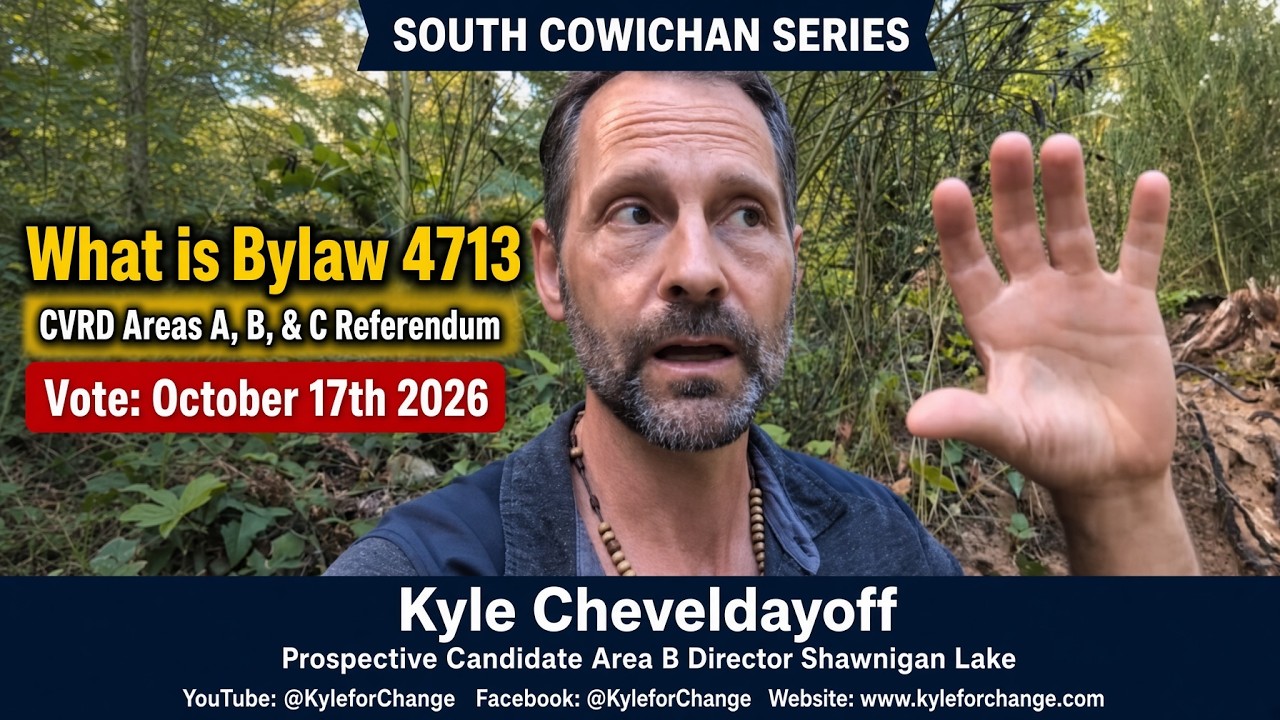
Kyle's South Cowichan Series, breaking down Bylaw 4713 in plain language
On October 17, 2026, eligible voters in Electoral Areas A (Mill Bay/Malahat), B (Shawnigan Lake), and C (Cobble Hill) will answer a second ballot question, separate from your vote for Director, about whether to create a dedicated fund to study local issues. This is called the South Cowichan Issues Assessment Studies Service, established under Bylaw No. 4713.
If passed, it authorizes up to $200,000 per year (roughly $23 to $24/year for an average home, based on assessed value) collected through property taxes starting in 2027, for an undisclosed period of time. I have inquired for more details and will update the public through YouTube videos and website updates.
At this point, I encourage the public to get as informed as possible before October 17, as that is where the referendum question will be answered. This page and my YouTube series are here to help with that.
"Are you in favour of the Cowichan Valley Regional District adopting Bylaw No. 4713 to provide for the following: (a) establishing the 'South Cowichan Issues Assessment Studies Service' within Electoral Areas A, B and C to provide funding for the completion of studies that address issues identified in Electoral Areas A, B and C; and (b) annually requisitioning up to a maximum of the greater of $200,000 or $0.0239883/$1,000 of taxable assessed value to pay for the service?"
Plain language (from CVRD): "Should the CVRD create a new fund to support future studies of local issues, services, and community-led participation options (e.g. advisory groups, citizen assemblies, committees, task force) in South Cowichan?"
Background
Electoral Areas A (Mill Bay/Malahat), B (Shawnigan Lake), and C (Cobble Hill) make up what the CVRD calls "South Cowichan," the southern, unincorporated portion of the Cowichan Valley. These three areas sit outside any municipal boundary, which is the key reason they face different challenges than places like Duncan or North Cowichan.
Unlike a municipality, residents of electoral areas do not have their own elected local council, dedicated planning department, or direct control over most services. Research found 25 separate sewage facilities operated by various groups in the South Cowichan plan area alone, and three watershed areas under simultaneous stress from water extraction and contamination.
This fragmented service picture, combined with rapid population growth, led the CVRD, in consultation with the BC Ministry of Municipal Affairs, to determine that a formal community issues assessment was needed specifically for this area. Other CVRD electoral areas were not included because the Province and CVRD identified South Cowichan as the area where gaps were most pressing.
Between March 2024 and February 2025, the CVRD commissioned EcoPlan International to conduct a South Cowichan Community Issues Assessment across four phases. The work included technical reviews, community forums in all three areas, pop-up events, First Nations government consultations, and an online/paper survey that received 412 responses.
Residents reported gaps and concerns in: transit access, recreation programming, emergency service coordination, community planning capacity, water infrastructure, and the overall level of services received compared to what municipalities provide.
The official finding, quoted directly from CVRD materials, was: "Additional community input and exploration of increasing community involvement in decision-making and engagement approaches may help more directly address local issues."
Critically, EcoPlan was scoping problems only, not prescribing solutions. Official materials state explicitly that the assessment would not provide a recommendation as to whether South Cowichan communities should become a municipality. The CVRD Board formally accepted the completed EcoPlan assessment on January 28, 2026.
Source: CVRD staff report to the Board, January 2026; 2024 South Cowichan Community Issues Assessment Final Report (EcoPlan International, commissioned by CVRD).
The EcoPlan assessment is done. Its conclusions are sitting on the CVRD Board's table. The obvious next question is: why can't the CVRD just commission follow-up studies out of existing budget, without going to a referendum about it?
The CVRD says it cannot dedicate an ongoing funding stream to these studies without first establishing a formal mechanism under the Local Government Act. Bylaw 4713 is how they propose to do that.
What I want to know before taking a position is whether that is the only way to get there. Specifically, I am asking whether existing Function 325 (Electoral Services) capacity or surplus could cover the required studies without a new tax line. I want to look at this from every angle before rushing to a conclusion, and I encourage residents to do the same.
Residents have been clear: no more new taxes, and less spent on consultants. With many CVRD projects currently on hold, there may be existing staff capacity that could be redirected to this work. The question worth asking is whether directors and staff could find ways to build that expertise internally, rather than creating a new service that depends on more external consultants and new tax dollars. I believe we should exhaust every option using what we already have before asking residents for more.
Under Part 10 of BC's Local Government Act (SBC 2015, c.1, s.332), a regional district board can establish a "service," which is a dedicated funding and delivery mechanism for a specific purpose. The Province of BC states directly: "Establishing a service does not create a new government. Rather, it is a funding and service delivery mechanism."
A regional district service is not a new government, not a municipality, and not a new layer of bureaucracy. It operates entirely within the existing CVRD board structure. The same elected directors you already vote for retain full control over how and whether funds are spent each year.
The Local Government Act (s.332(3)) also states that "services can be delivered directly by the regional district or through another public authority, person or organization." This means the service could engage external consultants, community organizations, or other public bodies to carry out the funded studies.
Source: Local Government Act, SBC 2015, c.1, s.332(3); BC Province guidance on regional district service establishing bylaws.
The official CVRD materials do not specify a fixed end date for the service. Bylaw 4713 sets a maximum annual requisition but does not mandate that the maximum is collected every year, or for a set number of years.
The CVRD has stated: "The Board is not required, and does not expect, to requisition the maximum amount every year." Because this service is specifically designed to fund studies and not ongoing operations, it is reasonable to expect the service would be wound down once those studies are completed and acted upon. However, the bylaw does not contain a built-in expiry date. The Board would need to formally repeal or amend it to end the service.
I am asking the CVRD directly about the expected duration and will update this page when I have a clear answer. Voters deserve to know not just the annual cost, but roughly how many years this tax is expected to apply.
According to official CVRD referendum materials, if passed the service would fund:
- →Further defining and studying the community issues identified in the EcoPlan assessment
- →Assessing local services and exploring community participation options. The CVRD plain language version explicitly lists advisory groups, citizen assemblies, committees, and task forces as examples. Other models include Standing Committees, Advisory Planning Commissions, participatory budgeting processes, Youth Advisory Councils, Climate and Resilience Panels, and community engagement platforms
- →Developing implementation strategies for identified issues
- →Assessing whether pooling resources or restructuring administration could address infrastructure needs more efficiently
What it does NOT do: decide whether South Cowichan becomes a municipality; create specific advisory groups immediately; fund capital projects; or make any governance changes. Any future advisory bodies would require additional CVRD Board approval. Governance and incorporation feasibility is one type of study the bylaw could fund, but this referendum does not decide whether incorporation ever happens.
Kyle's Opinion on the Referendum
My intent is to dig deeper into this topic and give residents the full picture so the October 17 decision is well informed. I have been speaking directly with the public, local Directors, Councilors and other interested groups to understand the complexity of this.
I agree with the immediate public reaction of "No New Taxes" while also recognizing that this is a complex issue I need to understand better and to think outside the box for new solutions and possible funding such as:
- •Whether the studies this Service would fund could instead be covered through existing CVRD budget capacity or surpluses from previous years.
- •Could CVRD staff be used in place of consultant costs that eat up our budgets?
- •Could past Services be amended to absorb the costs outlined in the Referendum?
Community trust in CVRD decision-making has been strained, and I want to help Shawnigan Lake residents and the greater South Cowichan areas understand the scope of what the Referendum is before voting Yes or No. How this referendum is handled can either help rebuild that trust, or further erode it. Residents deserve honest, plain-language answers, not bureaucratic framing, and I'm trying to assist with this.
Key Facts
Key Facts About the Referendum (Bylaw 4713)
- →Who votes: Registered voters in Electoral Areas A, B, and C only
- →YES vote: Establishes the service; up to $200,000/yr collected via property tax starting 2027 budget cycle
- →NO vote: Bylaw cannot proceed; CVRD Board will propose alternative options
- →Cost per home: Area A ~$23.06/yr | Area B ~$24.41/yr | Area C ~$22.04/yr (averages based on maximum requisition)
- →Duration: No fixed end date. The service continues until the Board formally repeals the bylaw. The Board is not required to collect the maximum each year
- →This is NOT: a vote on incorporation, a new municipality, a new government, or any specific service change
Estimated Annual Cost Per Household (by Area)
| Electoral Area | Avg. Assessed Value | Est. Annual Tax |
|---|---|---|
| Area A (Mill Bay/Malahat) | $961,445 | ~$23.06/yr |
| Area B (Shawnigan Lake) | $1,017,536 | ~$24.41/yr |
| Area C (Cobble Hill) | $918,791 | ~$22.04/yr |
Based on the maximum requisition rate of $0.0239883/$1,000 taxable assessed value. Your actual tax depends on your property's assessed value. Source: CVRD Bylaw 4713 referendum materials.
Am I in Electoral Area B?
Shawnigan Lake's electoral boundary is larger than most people realize. Use the official CVRD boundary map to confirm your address is in Area B before October 17.
🏠 Look Up Your AddressArticles, statements, and local media covering the October 17 election and the bylaw disputes that led to it. New items added as published.
The Issues Driving This Election
The October 17 election follows one of the most contentious periods in CVRD history. Two major planning bylaws faced intense community opposition, and the board elected October 17 will decide what comes next.
Bylaw 4710 (Comprehensive Zoning Bylaw): Paused by the CVRD board on April 22, 2026, after significant community pushback. Tens of thousands of residents joined social media groups opposing the bylaw. The pause means it has not been adopted or repealed. The new board will have to decide its fate.
OCP Bylaw 4373: Adopted by the board in November 2025 and also contested. On May 27, 2026, the board voted 5 to 4 to begin the repeal process and to reinstate the previous Harmonized OCP (Bylaw 4270). These decisions are not yet finalized. The new board elected October 17 will see this through.
The energy from that community mobilization matters now. The directors you elect on October 17 will make the calls on these unresolved bylaws. If you were engaged in spring 2026, this election is the follow-through.
CVRD Board Meeting: OCP for Shawnigan Area
An upcoming CVRD board meeting includes an agenda item on the OCP for the Shawnigan area. Watch for the confirmed date, time, and location.
View the CVRD meeting agenda →The Little Valley That Could - And a Big B.C. Win
COAP's account of how Cowichan Valley residents organized to challenge the Modernized OCP and Comprehensive Zoning Bylaw. Covers the Facebook organizing, packed meetings, and the April 22 board vote to pause all MOCP-related work until after the October election.
Read on Substack →Cowichan Valley Land-Use Backlash Highlights Tension Between Global Goals and Local Concerns
Reporter Paul Rowan Brian covers the April 22 pause on the comprehensive zoning bylaw overhaul, quoting board chair Kate Segall acknowledging the initiative "caused real frustration and division and loss of trust." Places the local fight in the context of similar zoning conflicts across Canada.
Read the article →Rural Residents Win Zoning Fight
CHEK News covered the community fight against Bylaw 4710. Kyle spoke with CHEK about what happened and what it means for residents in the Cowichan Valley.
Watch on YouTube →Behind the backlash to the Cowichan Valley's comprehensive zoning bylaw
Reporter Eric Richards examines the community opposition to Bylaw 4710 and the role social media and COAP played in the backlash that led the CVRD board to pause the bylaw on April 22, 2026.
Read the article (thediscourse.ca) →Discourse Article - Yes We Read It.
COAP responds to The Discourse article, arguing the community opposition to Bylaw 4710 was organic and grassroots, and announces a detailed rebuttal.
Read on Substack →We Investigated Government. The Discourse Investigated Us.
COAP's full response to The Discourse piece, arguing the reporter shifted focus from covering the bylaw itself to investigating COAP's motives and organization.
Read on Substack →We Need More Civic Engagement! A little story about a Town Hall...
COAP writes about their community town hall, which faced online harassment, and what that says about the challenges of civic participation right now.
Read on Substack →Kyle's YouTube Series: South Cowichan
Kyle is publishing a plain-language video series breaking down the referendum and other election issues directly for residents. New episodes are added as more information becomes available.
▶ Watch on YouTube